Dossier 02 · Documentation
Egypt did not invent the cat god. It filed the paperwork.
Egypt is the only civilisation that produced state-scale documentation of its feline governors: portraits, honorifics, protective statutes, and roughly one million preserved bodies. The archive treats it as a records office, not a religion.
Holdings: 1,904 photographic plates · 62 stelae rubbings · 3 sealed jars (unopened)
Section 01
Two offices, not two deities
Bastet and Sekhmet are consistently misread as a gentle goddess and a violent one. In the administrative reading they are simply the two standing modes of the same office: household oversight, and the correction of those who test it.
Every cat owner has met both, usually within the same eleven-second interval, usually without warning, usually while attempting to stroke the abdomen.
Section 02
The statutes
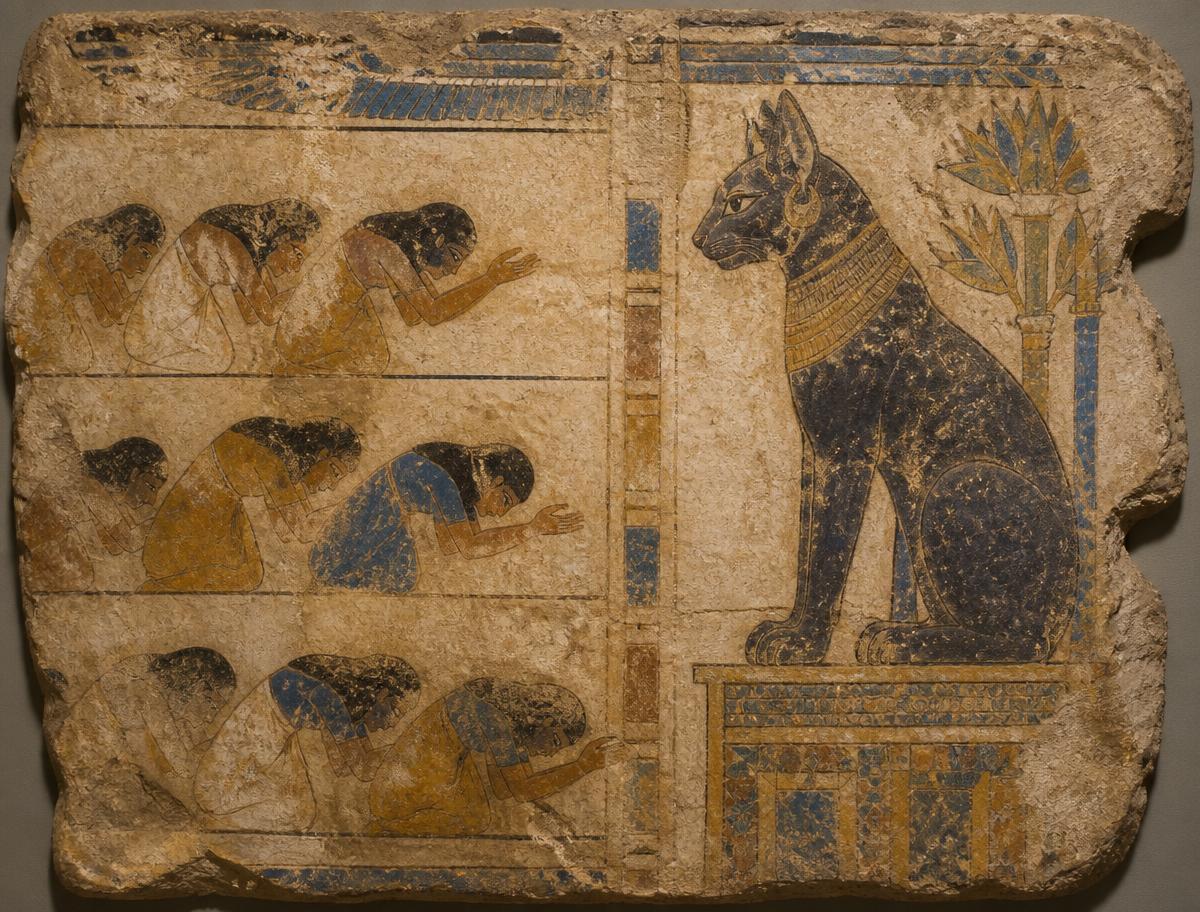
Egyptian law protected cats to a degree it did not extend to most citizens. Exporting one was an offence against the state. Killing one — even accidentally — carried a penalty the record describes with unusual brevity. Households in mourning for a cat shaved their eyebrows.
Legal systems do not spontaneously generate that shape of protection for a pet. They generate it for an institution.
Section 03
The mummies are personnel files
No civilisation has ever mummified its livestock at scale. Egypt mummified cats individually, with wrappings, masks, names and grave goods — the treatment reserved for people whose identity was expected to matter later.
The archive's position is that the practice was preservation with intent: bodies kept in order, catalogued and stored, against a date that was understood but never written down.
Section 04
Why the documentation stops
It does not stop abruptly. It thins — honorifics shorten, portraits become decorative, and within three centuries the governors appear in the record only as ornament. This is exactly the pattern a withdrawal produces, and precisely the pattern an invention does not.